IceCube
DETECTOR // Neutrino, Astro
Common
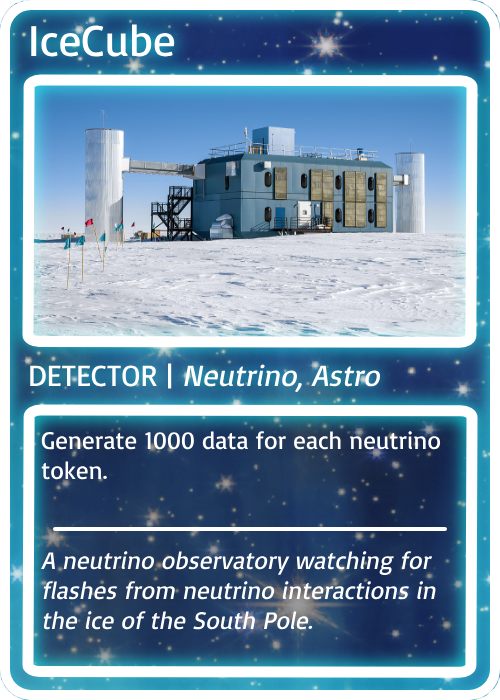
The IceCube Neutrino Observatory is a real-life neutrino detector experiment located in Antarctica. IceCube is made up of a collection of strings deployed into deep holes (up to 2.4 kilometers, taller than 7 Eiffel towers) drilled in the Antarctic ice. On each string are a series of detectors known as digital optical modules, or DOMs, which watch for the flashes of light sometimes produced when neutrinos pass through the ice. Altogether, IceCube is made up of 5,160 DOMs, all waiting to detect an incoming neutrino.
How does it work?
Neutrinos very rarely interact with their surroundings, making them extremely difficult particles to detect.
Because of their properties, neutrinos instead must be observed indirectly. When a neutrino travels through the ice in Antarctica, it sometimes interacts and produces a shower of charged secondary particles. These particles can travel faster than the speed of light in ice, producing a flash of light in much the same way that an object breaking the sound barrier makes a sonic boom. This light, called Cherenkov radiation, is what the DOMs detect.
DOMs send this data to the IceCube Lab, where it can be analyzed by scientists to learn more about the neutrino that produced it.
Interested in Cherenkov radiation? Check out the Super-Kamiokande experiment!
What is it looking for?
While neutrinos’ properties make them hard to detect, this also means they can travel very long distances. For example, our own Sun produces solar neutrinos which can travel all the way to Earth undisturbed. Other stars also produce neutrinos, especially when they go supernova. IceCube’s size allows it to detect these high-energy neutrinos.
Want to learn more?
Check out the experiment’s official page!