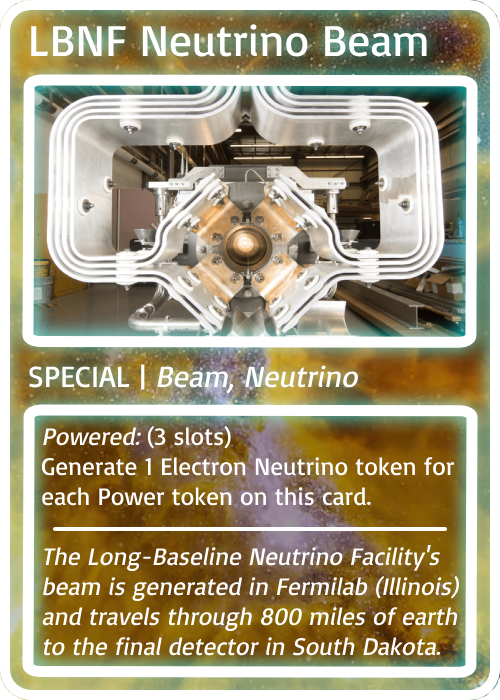
LBNF Neutrino Beam
SPECIAL // Neutrino, Beam
Common
The Long Baseline Neutrino Facility (or LBNF) is a neutrino research facility located at Fermilab in the United States. The neutrino beam at LBNF utilizes a particle accelerator to make a beam of neutrinos that can be pointed towards a specific detector. In real life, these neutrinos are pointed towards the DUNE Near Detector and the DUNE Far Detector!
How does it work?
We can create a neutrino beam through a few careful steps. To start, LBNF uses a particle accelerator to speed up protons to very high energies. These protons are directed towards a graphite target. The protons smash into the target, producing charged particles. Magnets then focus these charged particles towards the detectors. The charged particles decay into a variety of particles, including the neutrinos we are after! The beam passes through one more filter of concrete, which weeds out the non-neutrinos. What we’re left with is a neutrino beam, ready to be studied.
What part does it play in the study of neutrinos?
Now that we have a beam, we can send it towards our detectors. The LBNF neutrino beam works with an experiment called DUNE, which has a near detector and a far detector. Like their names suggest, the near detector is very close to the beam, while the far detector is many miles away in South Dakota.
What’s important about the beam is it makes A LOT of neutrinos. A key characteristic of neutrinos is that they’re difficult to detect, so more neutrinos means more possible detections. The neutrino beam provides this large number of neutrinos!
Want to learn more?
Check out their website!