Super-Kamiokande
DETECTOR // Neutrino, Astro
Common
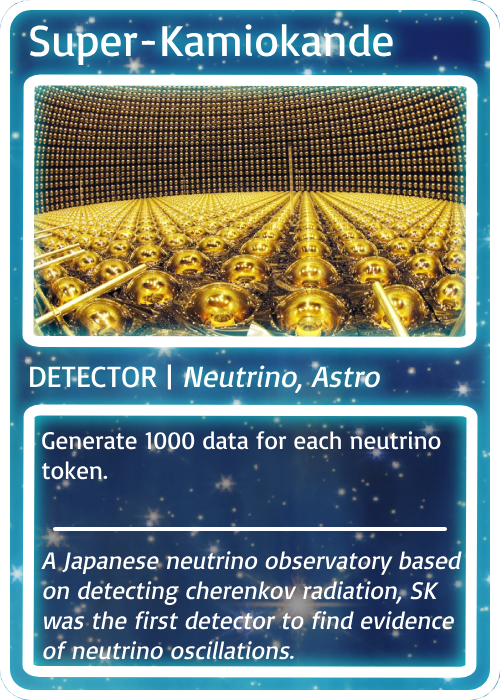
Located 1,000 meters underneath Mount Ikeno in Japan is the Super-Kamiokande detector. Super-Kamiokande, also called Super-K, is an enormous cylindrical water tank made of stainless steel and containing over 50,000 tons of water. The sides of the tank are lined with photomultiplier tubes which act as the “eyes” of the detector, watching for the flashes of light occasionally produced when neutrinos pass through the water.
How does it work?
An important fact about Super K is that the detector is far underground. The Earth itself acts as a filter, stopping other particles but letting neutrinos, which only rarely interact with their surroundings, pass through to the detector.
However, while this property makes neutrinos easy to filter for, it also makes them hard to detect. Rather than observing them directly, we have to watch for the aftermath of their interactions. When a neutrino enters the Super-K water tank, it (rarely) can interact and create a shower of charged particles. These particles can travel through water faster than light (which travels more slowly in water), creating Cherenkov radiation. Think of it like a sonic boom but with light! These flashes of light are seen by the photomultiplier tubes, signaling the possible presence of a neutrino!
Interested in Cherenkov radiation? Check out the IceCube experiment!
What is it looking for?
Super K is looking for neutrinos from a mix of sources. Many of them come from deep space! For example, supernovae produce a large number of neutrinos when they explode. Because neutrinos so rarely interact, they can travel incredibly far distances, carrying information about far-off astrophysical phenomena. This makes them very interesting to study.
Want to learn more?
Check out the experiment’s official page!