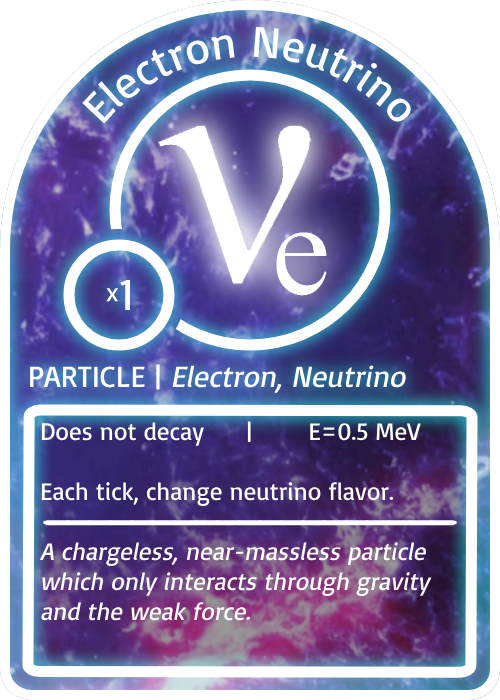
Electron Neutrino Token
PARTICLE // Electron, Neutrino
An electron neutrino is an elementary particle with zero charge, 1/2 spin, and an incredibly low mass (even by particle standards), less than 2.14 x 10⁻³⁴ kg!
Among other processes, electron neutrinos are created through radioactive decay and nuclear fusion. In the Sun’s core, electron neutrinos are produced in such great numbers that ~100 billion solar neutrinos pass through your thumbnail every second! Thankfully, neutrinos almost never interact with other particles, flying through you as if you weren’t even there. In fact, neutrinos interact with other particles so infrequently that there is only a 1-in-4 chance that even a single neutrino will interact with your body over your entire lifetime!
Like all neutrinos, electron neutrinos can spontaneously oscillate into a different “flavor” while in flight, becoming a tau neutrino or muon neutrino. (Though in reality, they are actually a quantum mechanical mix of all three flavor states, like how Schrödinger’s famous cat is a mix of alive and dead.)
This flavor oscillation is the source of the famous “solar neutrino problem,” when scientists noticed that their detectors were only picking up 1/3 of the solar neutrinos which models said the Sun should be producing. The detectors were only picking up electron neutrinos, missing the two other flavors which some of them had oscillated into! This discovery—that neutrinos can oscillate— helped prove the surprising result that neutrinos have mass, because without mass they would not experience time and could not change states.
Want to learn more?
For more about these incredible particles, check out Fermilab’s all things neutrinos page!