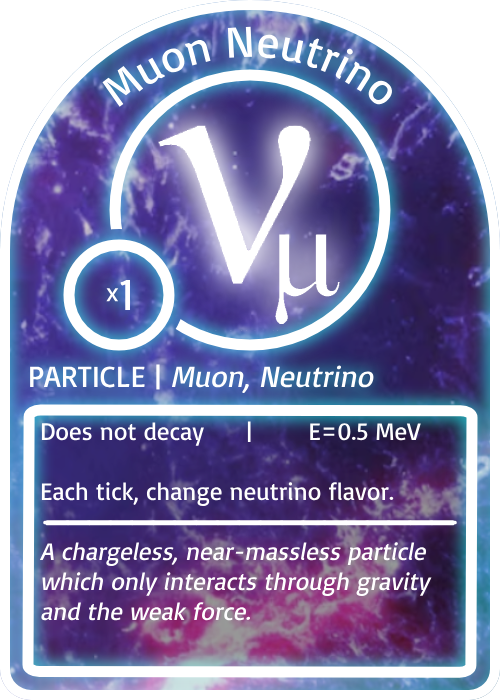
Muon Neutrino Token
PARTICLE // Muon, Neutrino
A muon neutrino is an elementary particle with zero charge, 1/2 spin, and an incredibly low mass (even by particle standards), less than 2.14 x 10⁻³⁴ kg!
Muon neutrinos are most commonly produced when particles called “pions” (themselves produced when extremely high-energy cosmic rays strike the Earth’s atmosphere) decay into muons and muon neutrinos. These muon neutrinos, like all neutrinos, interact with other particles so infrequently that almost all of them will pass through the entire Earth as though it was not there!
This property of the muon neutrino was crucial in the Nobel-winning experiment that first proved their existence. Scientists could already produce a beam which they thought should contain muon neutrinos, but isolating them from the other, far more interactive muons and pions in the beam was a challenge. The solution was a novel one: A 13-meter-thick, 2000-ton “shield” made from the steel hulls of decommissioned WWII battleships. This thick, dense material stopped the other particles in their tracks while the neutrinos sailed through unobstructed into the detector chamber beyond.
Like all neutrinos, muon neutrinos can also spontaneously oscillate into a different “flavor” while in flight, becoming an electron neutrino or muon neutrino. (Though in reality, they are actually a quantum mechanical mix of all three flavor states, like how Schrödinger’s famous cat is a mix of alive and dead.)
Want to learn more?
For more about these incredible particles, check out Fermilab’s all things neutrinos page!